By Pat Gaffney
1 August 2019

Pat Gaffney (second from left) on a march against the 1991 Iraq War. Photo: Giovanni Scudiero
After 29 years of being the general secretary of the Catholic peace organisation, Pax Christi UK, Pat Gaffney stepped down in April. This first part of our interview with Pat covers the years before Pax Christi – liberation theology, death squads, direct action and new models of education.
The first time I took part in direct action was amazingly powerful, at every level. It was with Catholic Peace Action on 14 April 1983.
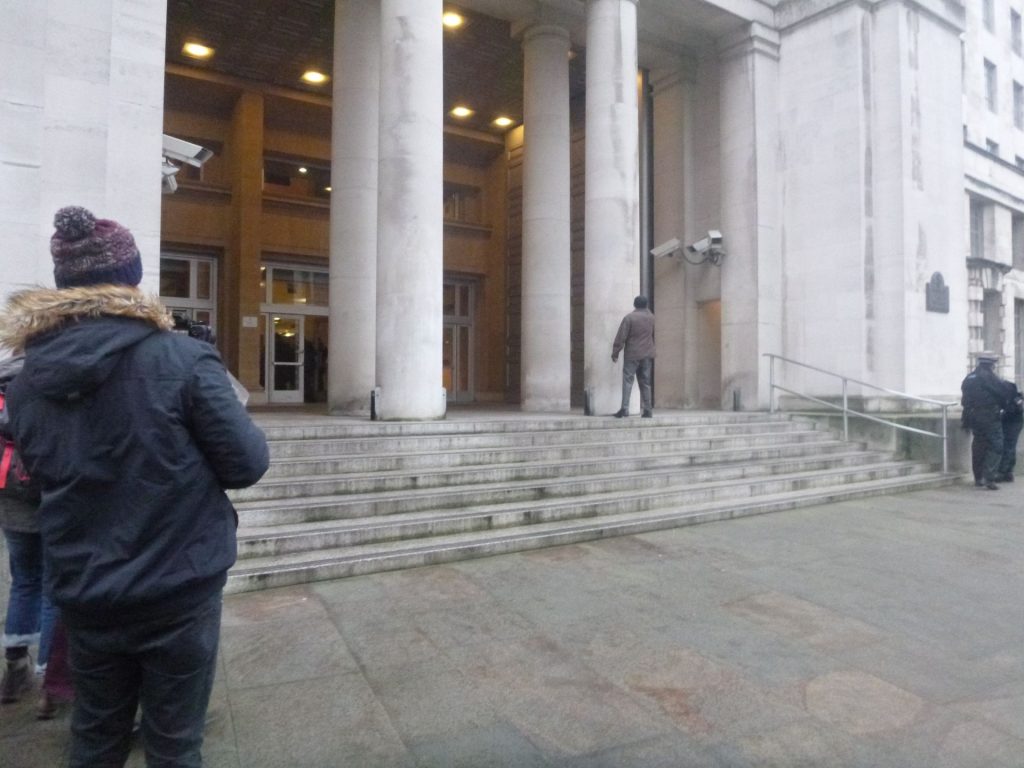
We decided we were going to pour our own blood over the doorway and steps of the ministry of defence in London, and scatter ashes.
The symbolism was: this is the blood that would be spilled and this is the ash that would be created if there was a nuclear war. Those things also have powerful meaning in scripture.
I remember several days before, one of our group decided he would take our blood from us. That was a pretty profound evening for us, where we were all literally giving our blood that was going to be part of a peace action, a pledge of our commitment and love.
We burned letters and memorabilia that meant something to us, that were also going to be part of this peace action. It was very powerful preparation.
On the day itself, I remember almost going into a zone, walking up these steps and just focusing on: ‘I want to shed this blood here, I want to spread this ash here, and then I just want to kneel and wait.’ I remember being very focused down into a zone to get you through what you’re doing. So that was my first step into civil disobedience.
Looking back, it was a very dramatic action to start one’s direct action with.
Four of us were arrested and that just began the whole sequence of being arrested and charged and then going through the court system and attempting to use that court experience to further tell the story of what you’re doing and why you’re doing it and what you’re challenging. Then taking the consequences of that further.
Sharing nonviolence
If I look back to the ’80s, when I was just beginning to discover nonviolence, through doing actions but also from practitioners in this country and also from the Americans, I suppose I was responding to it personally: ‘I’ve got to try and be nonviolent as a person, in my lifestyle, and in the way I act when I do peace things.’
That’s still there, because I do think nonviolence is about life choices, more than just nonviolent direct actions.
“We were all, literally, giving our blood that was going to be part of a peace action.”
Now, because we’re trying to grow it, in the sense that we’re trying to help more and more people better understand what nonviolence is about, I do also see that it is something that can be taught: we should be better at sharing skills and communicating about it, strategising about it.
I see that happening in the Global South and there is a lot we in Britain can learn from there. Nonviolence can be woven into the way we do things – in schools, in communities, politically. There’s a huge toolbox there and there’s a lot more we could do with it.
Keep your roots
I grew up in Hillingdon, in West London, which, in the ’50s and ’60s, had a lot of Catholic migrants. A very Irish Catholic community in the school and the parish.
I had a very strong Catholic Irish identity, very working-class as well. I had lovely parents, just one brother – we’re very close, we’re just two years apart. We had a fantastic, very normal working-class childhood, playing in the street, doing things with church, doing things with your mates, over the fields at night, a lot of freedom.
My dad at that stage of his life worked at Pinewood film studios in the property and sets department, so he had quite a glamorous job for those times. Before that, he’d been a coal miner in Scotland.
My mum, when we were growing up, was with us at home and then did cleaning jobs and dinner lady jobs to be with us.
She was remarkable. She came over here from Ireland at 20, never had a formal education, but she decided in her 40s she wanted to be a nurse. She went off under her own steam and registered and trained, then became a district nurse. She created a whole life for herself.
When I look back on it, it’s amazing.
“I was a little boring conformist! I absolutely loved school.”
My dad was a shop steward, he was full of the Keir Hardie sense of socialism. Because he was born in 1907, he had a very strong sense of that period of time in Scotland.
I grew up with that, and the sense that you keep your roots: you don’t stray from your roots and your roots keep you straight. ‘Always keep the common touch’, that was very strong in our community; ‘don’t get above yourself’. Not in an oppressive way but in a social way.
The fact that my mum was so committed to nursing, to the health service, to serving people in her professional work and beyond that.
That was part of the culture, working people do this, you work together and you work with other people. It came across in that way, in a very organic way.
I used to hear a lot about Ireland, especially from my dad, he had the Charter for the Irish Free State up in his bedroom. There was a bit of this dangerous romantic notion of Irish freedom fighters, and of Catholicism over and against everybody else.
I was always hearing stories about Mary and Elizabeth, Mary queen of Scots. It seemed a bit more special to be Catholic, something to hold onto.
I loved being good
I was at a Catholic primary school that was, at that time, still run by religious sisters. It was very strict, focused. I didn’t pass my 11-plus,* I went to a new secondary modern. It was the very early days of that style of education. It was still very much looked down on. A lot of my friends were going to grammar school.
It was called the Douay Martyrs (after 158 Catholic priests who trained in Douai, France, who were executed in England in the 16th century) and quickly grew into a larger comprehensive school.
When I look back on it, and even then I appreciated it so much, the teaching, the teaching staff, the opportunities, were absolutely fantastic – singing in choirs, taking part in school plays, and being taken to the theatre.
That was because it was small, about 400–500 students, we were in it from the beginning of the school, they treated people as individuals. I felt very nurtured, but my brother, who was at the same school, had a very different experience.
That was because I was a conformist. I loved school, I loved all the structure, I loved being good and being patted on the head. And I loved joining clubs and being part of things. I was a little boring conformist! I absolutely loved it.
And the people there encouraged me to apply to go on to higher education. They would take us to visit colleges. We were working-class kids, none of our families had ever been to colleges or universities. Even to go and visit was a huge thing. All those doors were opened for me.
My parents were supportive of me going on to higher education, but not in a competitive way. They were of that old generation that said: ‘So long as you’re happy….’ To them, that was the important thing – you were a good person and you were happy.
People’s education
I always wanted to be a teacher. I think it was just bossiness!
I went on to Maria Assumpta College, a Catholic teacher training college – they don’t exist now, but they did back in the ’70s – it was part of London university, run by the Religious Sisters of the Assumption, it was all girls. It was a fantastic foundation.
“These models of education start with people’s lived experience, that’s the core.”
We don’t call it this now but it was vocational. You knew from the start that everything you were doing was to prepare you to work as a teacher.
You were doing psychology and philosophy, lots of practice, your own subject area, a lot of contact work with schools, a lot of good stuff about communication and how to teach, which, again, I don’t think is present today, but I felt provided me with skills way beyond my teaching. It was such a fantastic grounding.
You were constantly thinking about what it was to be a teacher and how you teach, and relationships, and the nature of education. We were reading Celebration of Awareness and Deschooling Society by Ivan Illich and Paulo Freire’s Pedagogy of the Oppressed.
These models of education and working with people that start with people’s lived experience, that’s the core, that’s the working material for what you want to reflect on and build on. Using language and accessing people’s experience in creative ways that don’t just rely on language but could use other things as well.
Recognising the value of common sense knowledge and experience. Recognising that most people have the ability to analyse things and question what’s going on in their lives. Also, moving away from the elitism of education. Saying: ‘No, it starts somewhere else, and it’s about something else.’
It was extremely new and challenging, but also, in some ways, it resonated back to my dad talking about worker education in Scotland among the mining communities and the power of the library system, or the hedge schools in Ireland.
There was a link to the sense that, yes, everyone has a right to access to this information and how we share it and how we get it and how we use it. It challenged the way we look at education here in this country.

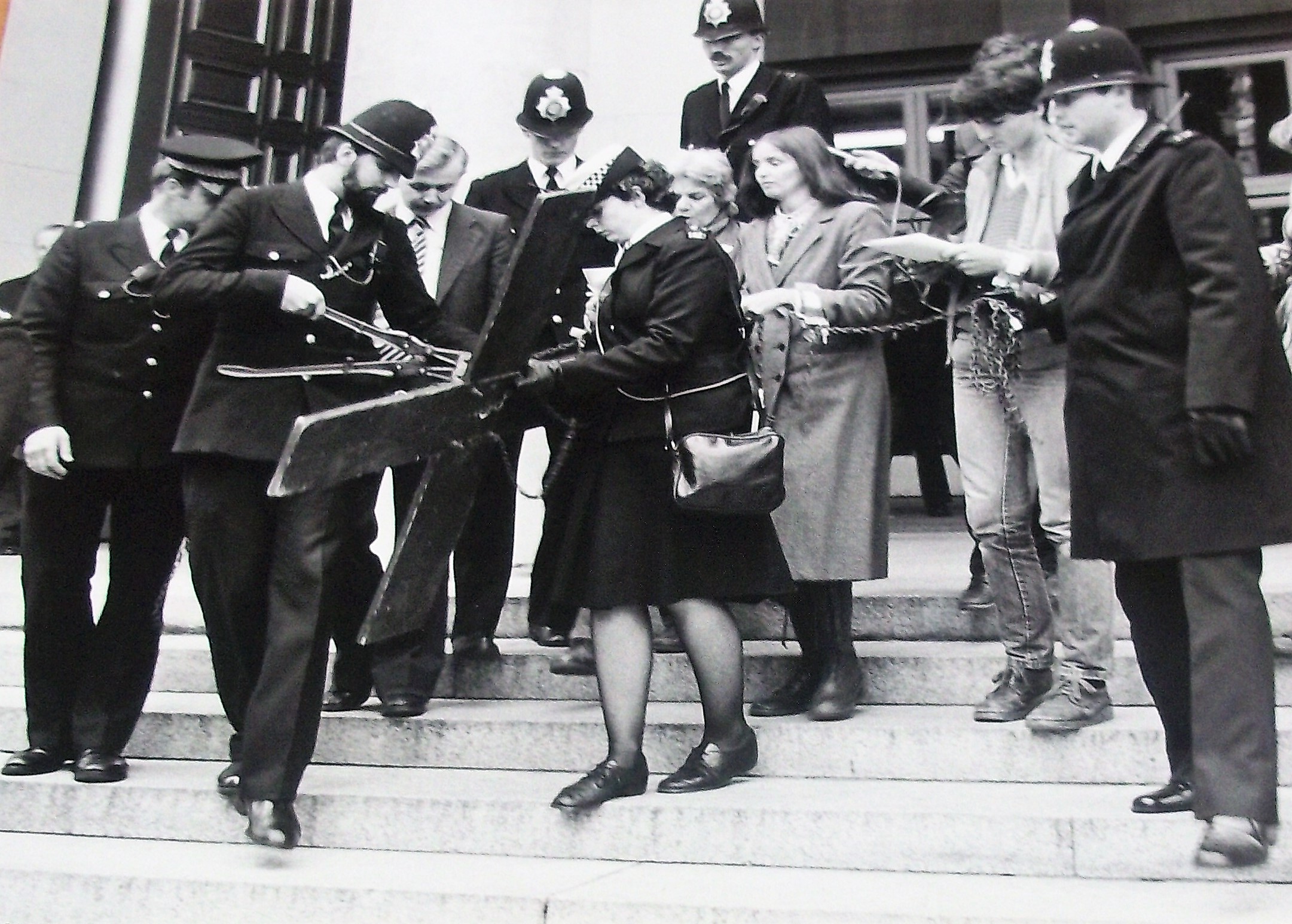
Pat Gaffney with a ‘Bread Not Bombs’ banner at the ministry of defence, Whitehall, during the 1984 visit to London of Mikhail Gorbachev, soon to be Soviet leader.
Liberation
We were also hearing, in Latin America, about this great thing of ‘liberation theology’, of the Catholic church going in a very different direction, identifying itself with the poor, with the oppressed, with people who were in social struggle.
You had movements in Chile, and Brazil, and Central America, where there would have been a lot of social unrest at the time, a lot of social injustice.
People in the church, not the whole church, but some priests and lay people and religious, were returning to the gospels and asking: ‘What does this have to say about what is going on in our society, our workplaces, our communities?’
They were recognising that the message of the gospels was about a challenge to the status quo and those who want to keep you down or repress you. Challenging that through education, through engaging politically, and – for some at that time – it would also have meant engaging in armed struggle.
That movement of liberation theology, in the church and beyond, said: ‘Well, if we’re serious about overcoming injustice and lack of democracy, we have to join the people’. In many of those countries, there was armed struggle, and there still is today. There was a big tension.
Some went down the route of saying: ‘It’s our role to support, even if we don’t take part in it, to support that armed struggle for freedom, for liberation.’ Others said: ‘It’s our role to support not through armed struggle but through other ways.’
That was a huge eye-opener to me, to what was happening, to what religion can do in society, how the church can be a positive agent for change, and how people can use their skills and resources to serve that.
It also had implications back here, for us. It brought in new styles of liturgy and worship that reflected more that commitment to the poor and nonviolence and challenging injustice.
I find it really hard to talk about faith because I don’t think faith is something that you have and then it’s with you. I think it’s something that you are constantly renewing.
I don’t think I have the certainty, 100 percent all the time, that I have faith.
To me, there’s a part of it which is the tradition I’ve been brought up in, that framework of Irish Catholicism. That created a structure of ritual and values and practices that were good – for me – and that helped me reflect and have a sense of ‘There are other things in life beyond family, beyond what you do… there’s a big community of people who believe in God; they practice it this way.’
Until, probably, I was in my 20s, I didn’t think much about faith as something beyond all that structure and that ritual.
It was when I went to Maria Assumpta College that I was exposed to this other level: It’s more than ritual and it’s more than practice. It’s to do with values. It is to do with mystery, it is to do with something that is unexplainable. And that’s why it becomes so difficult to talk about.
It challenged me a lot that there’s something more serious to this faith thing. It’s not just about ritual, going to church, giving yourself a label. It is about your relationships and how you see yourself in the world, what guides that. And doing that with others who share that vision. And doing that out of a history and a tradition.
I was tremendously fortunate to be at a college that exposed us to what was going on in the Catholic church in the 1970s, in Latin America and in Africa in particular. Where the church was really taking off and seeing itself as really serving people.
The college also made us think: ‘Okay, what does this say to you, as you want to become a teacher? As someone who wants to be living in the world identifying as a Catholic person of faith?’
I suppose a bit of intellectual thought came to that but more of it was the practice, of people putting what they believed in into practice. That set the groundwork for me.
Moving on
In my early teaching, my subject was science and biology, I wasn’t able to do a huge amount around that.
I was teaching in West London, in a Catholic comprehensive, the same school I had been to! It was very comfortable being there again, it was just like another phase.
I taught science, but we all had to teach religious education, I suppose that’s where I had a bit of a chance to bring in what’s going on in the world.
After about six years, we heard about the changes coming down the pipeline, the national curriculum and more administration. That didn’t attract me. I thought, either I could stay here in this school because it’s so comfortable, forever and ever, or I move now. I decided to move.
I had nothing other than my teaching background to offer, so I went and did another course for a year. It was a retraining course where we did some human resources stuff, economics, management. It was very useful but, half way through, I thought: there is no way I could go into business or commerce or anything like that.
I started writing round to Oxfam and Christian Aid and Amnesty. I wrote to all these agencies working on development or human rights issues. I just said: ‘I will come and do anything, I will stuff envelopes, I will do anything you like, I want to use my background, all these things I’ve done, I’ll just come and do anything.’
CAFOD, which is the Catholic aid agency, wrote back and said: ‘Well, we’re actually starting an education department, come along and have a chat.’ It was the era when you went along and had a chat. They said: ‘You can start next week.’ So that is what I did.
Death Squads
In 1980, I started working with CAFOD, which was a very small agency at that time.
Today, if you applied for a job in a development agency, you have to have three degrees, 20 years’ worth of experience, proven this, proven that, proven the other. I just got in on a letter and enthusiasm!
I was able to create an education programme, providing resources and teaching input on teaching about the causes of poverty and the causes of underdevelopment. I was just at the right place at the right time. I was very, very lucky.
I was exposed then to another amazing group of people and more amazing stories from the Global South. It was a deepening of all that stuff that started at college.
We were meeting people almost weekly who were coming over from El Salvador, from Nicaragua, who were living under death threats, who were challenging death squads, people from South Africa who were challenging apartheid.
We were meeting the most amazing people, whose lives were at risk on the ground, who were committed to staying where they were, working with the people they were working with, but who were also pushing us in the First World to say: ‘You’re part of the problem here.’
I then became aware of the role of education in opening up those stories to communities here, opening up those stories to young people to reflect on how systems work, what’s going on in the world, opening up opportunities for us as an agency, and then the church, to be a voice for change.
“Nonviolence can be woven into the way we do things – in schools, in communities, politically.”
It was just mind-blowing, really, to be in your late 20s and exposed to all these people.
You were seeing the real dark side of what was going on in communities but you were also seeing amazing push-through and hope and sticking power of the people.
These would all have been Catholics or Christians from other traditions, working out of a faith base.
I suppose that is when I started to become a bit more about the nonviolent dynamic as well, realising that a lot of these people were living in situations of violence, were experiencing violence, seeing what violence was doing to people, and were there on the ground trying to change that but not going down the armed struggle route.
I couldn’t frame that clearly in my head at the time, but I was very impressed with the sense that these people were ready to absorb the violence that is going on around them.
I do remember reading from the Philippines, there were some Filipino and Irish Catholic priests who were imprisoned at the time for doing human rights work, I remember one of them writing that one of the roles, he felt as a Catholic, was to absorb the violence around you and stop it being passed onto other people. I remember that sticking in my head for some reason.
It wasn’t in a ‘walk over me’ kind of way, it was: ‘By challenging, we are absorbing some of this violence – we have to challenge it’. It was just beginning to make me realise that there were other ways of doing things and people are taking risks and there was an element of sacrifice in there, though people wouldn’t say that.
It brings a different meaning to solidarity when you are with people in that way. It’s a different quality of solidarity.
Direct Action
Work was pretty all-consuming, but I didn’t see it like that. I didn’t experience it like that. It took a lot of weekends, it took a lot of evenings. It was great. I didn’t think of it as slogging work.
I was lucky, my work was taking me out and about. I was going into schools and doing stuff with young people and doing in-service training with teachers.
At weekends, doing adult education work. I was just meeting lovely people all the time, so it was just great.
Everything spilled over, there weren’t clear lines of: ‘Now I’ve got to have fun’; ‘Now I’ve got to work’. I was very lucky and I do acknowledge that very much. When you look at the way some people have to work, and the nature of work, I just think I’ve been so lucky.
In the ’80s, we set up Catholic Peace Action, all these things were interconnected.
In the 1980s, I met up with these great people who were, initially, challenging the militarism of the Falklands War, and we were meeting once every couple of weeks for discussion. We were reflecting on scripture, what was going on in the world, in order to prepare ourselves as an affinity group, a group that could begin to take more direct action against militarism.
We decided that, for us, because we were all London-based, the focus for any of our activities was going to be the ministry of defence in Whitehall.
We decided that, for us, the thing we’d be challenging would be nuclear war preparations because that was the era of moving from Polaris nuclear missile submarines to Trident nuclear missile submarines.
That was amazing, meeting specifically to reflect about what these policies of nuclear weapons and deterrence were doing to our country, to us as people.
We were also learning from what was going on elsewhere, from the peace movement in America, learning out of the Vietnam experience, of how they challenged that war. We were kind of building up experiences and practices that would help us begin to take action at the MoD in Whitehall.
It was a small group to start with, the core people were: Dan Martin and Carmel Martin and their young family; Sarah Hipperson, who went on to be a Greenham Common woman; Sarah Grayson, a mother in South London; Liz Yates, who was a religious sister, who’d worked overseas; Ray Towey, who was a doctor at Guy’s Hospital, who’d worked for many years as a missionary in Africa as a mission doctor; Tony Bartlet, a Catholic priest; Linda Frewin, a theology student; and myself.
We had a whole year of meeting, discussing, learning.
What does civil disobedience mean? What does nonviolence mean? What are the implications? How do we bring those into this arena, here in London? How do we frame activities that challenge? How do we create actions that take you over the line? How do we plan for the consequences of these actions? How do we communicate about it?
It was well over a year of all that before we did anything. Then we started taking action in the early ’80s at the ministry of defence, using religious days that had a significance and a meaning that could be both secular and religious.
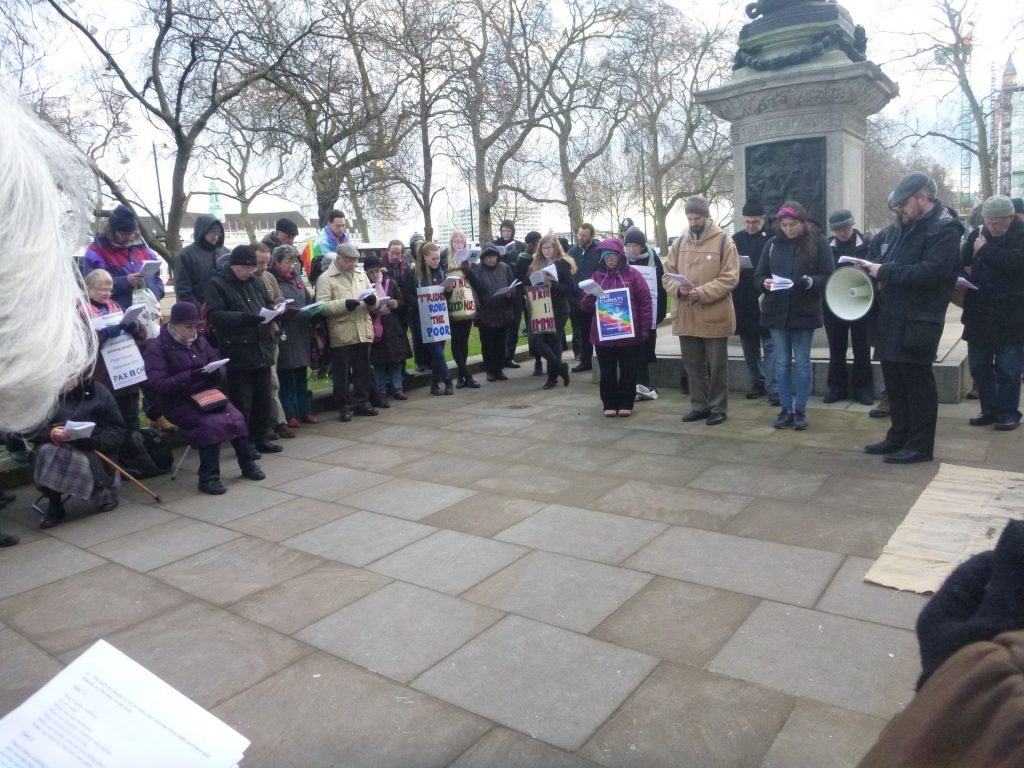
Some of those actions continue today. For example, the actions we do on Ash Wednesday have been going on continually for 38 years, so we’ve created a tradition of Christians being at the ministry of defence on Ash Wednesday to challenge nuclear weapons policies, and we’ve maintained a community who’ve come and want to do that every year, which I think is pretty amazing.

Pat Gaffney marks the ministry of defence in London, Ash Wednesday, 1992.
Represent
That first arrest, after pouring blood on the MoD steps, came before the Ash Wednesday actions. It was a very dramatic action based very much on one of the US peace actions.
It’s quite hard to remember that far back, but my memory is the police were quite respectful.
It must have been a mystery to these poor policemen, coming into a place and seeing blood. How worrying that must have been. Where did this blood come from? Was somebody hurt? There must have been all those things going on in their minds, which I hadn’t thought about.
We were held in the old cells at the back of Rochester Row, very old police cells behind Portcullis House, as it is now. I remember just being there with other people and we sang, we prayed, we were released later that day.
Eventually we went back to Bow Street magistrates’ court. That first trial, we were partially represented – which helped make up our minds that we would never be represented by a lawyer again!
“I do think nonviolence is about life choices, more than just nonviolent direct actions.”
I think it’s very difficult for someone wearing a legal hat to represent you because they’re doing it through the lens of the legal system and you want to do it through a slightly different lens.
A strong plank of what we wanted to say was that we had a legitimate cause. We wanted to talk about motivation and the imminence of the nuclear threat. You can only do that speaking for yourself, it’s speaking out of belief.
A couple of us were charged with contempt of court on the day, for persisting in reading out our personal statements of intent, and taken down to the cells and brought back up. The magistrate was terrified – we had a Catholic priest arrested in our group.
I think the magistrate dealt with us very quickly to get rid of us. We got a conditional discharge which was to last a year; if we broke the law again it would be taken into account. [They didn’t receive a fine, or community service or a prison sentence – ed]
Subsequently, we always represented ourselves.
I found it very helpful when we were able to cross-examine one another, because that is a good way of further bringing out motivation and also clarifying the nonviolent nature of the action and clarifying the lack of threat that you were bringing to the situation, and all that was important to me as well.
That’s what I was doing in the ’80s in my spare time!
—
- The 11-plus exam (taken in England, Wales and Northern Ireland when you were about 11 years old) decided what kind of secondary school you went to. A grammar school was for more academic students who were likely to go to university. A secondary modern delivered more basic, more practical education, and rarely offered A-levels. By 1975, most local authorities in England and Wales had abandoned the 11-plus, which was criticised as giving most children a sense of failure. Northern Ireland held its last 11-plus exam in 2008. — ed
Pat Gaffney has been arrested 11 times for her civil disobedience actions, and has been imprisoned three times. She has refused to pay fines and has been visited by bailiffs, but has never had any property seized. The second part of this interview with Pat will appear in the next issue.
First Published in Peace News
https://www.peacenews.info/node/9442/making-nonviolent-faith