Continuing our series on Peace, Carmel Martin, anti-nuclear activist, defends our right to live
ON JULY 23, 1986, my third child, a daughter, was born. I rejoiced at the wonder of creation and this new life entrusted to my care.
When I was only 15 weeks pregnant, a time in which a woman could legally have an abortion, I visited the hospital for an ultra sound scan. Through this new technology I clearly saw, much to my astonishment, the child within me sucking her thumb and kicking her legs vigorously, and I couldn’t feel a thing! She was so tiny and yet so alive and human.
To think of abortion fills me with great sorrow, but I am much sadder to hear that even christians are among its supporters, or are at least confused about where they stand. They use the many pro-abortion arguments which place the humanity and life of the unborn child lower down the scale of values. The key assumption in favour of abortion is that the fetus is not human enough to be accorded the human rights that people outside the womb are supposed to have. The basic right to life is denied to what is a unique human being in the prenatal stage of their existence. This is a scientific/medical fact which is often over shadowed by other considerations.
Many men and women do not want to bring the child within the womb to full development for social, cultural, economic or political reasons. Tied up with all these reasons is the “women’s right to choose” argument, which states that the final decision is to be taken by the woman who is pregnant and who alone bears the burden of the pregnancy, birth, and often child rearing. I understand and sympathise with the physical and emotional traumas some women experience; especially if the child-to-be is unplanned and unwanted, or handicapped, or the result of rape; or if the woman/family lives in dire poverty.
I can only make a plea to the mother for the right to life of the child who is innocent and voiceless.
To others and society I say that if we really love and care for the unborn, we need to love and care for mothers. In a more just society of better health care, less poverty and more community support, women will choose abortion less often. Men need to take more responsibility for reproduction, for fighting everything that oppresses women from pornography to rape, and for child-care. Finally, we need to make adoption more acceptable as a nonviolent solution to an ‘unwanted’ child.
The same confusion of values and sometimes callousness regarding unborn children, is reflected in the justification for the possible use of nuclear weapons, which would result in the slaughter of millions of innocent people. In the deadly game of military and economic domination people are expendable. Their life is not as important as our values, our politics, our lifestyle. Mother Theresa drew the connection quite clearly when she said that once society accepts the killing of the unborn, all that is left for us to do is to kill each other.
This we are planning with great speed and ingenuity. There are enough weapons to kill everyone many times over, and more are planned (eg HM Government’s plan to buy Trident submarines). And even if only a small percentage of the world’s 50,000 nuclear weapons were used, climatic changes would result in the destruction or at least a fundamental change to life as we know it. The use of nuclear weapons would not only be murderous but suicidal and yet, as if the rulers of this world have gone mad or believe themselves to be gods, that is exactly what is planned and contemplated.
What else connects these two issues?
Nuclear radiation is most especially lethal to unborn children. The nuclear industry (weapons and power) is causing abortion and birth defects now through radio-active contamination of the environment. Women who survived the nuclear explosions of Hiroshima and Nagasaki later gave birth to deformed children. Women in the South Pacific and Australia who were exposed to nuclear testing by the US, French, and British governments also gave birth to deformed children. This genetic damage will be passed on from one generation to the next.
The language of abortion and war dehumanises the victims. In wartime entire nations are called “Reds”, “Communists”, “Fascists”, “members of an evil empire”. The millions of innocent civilians who would be killed in a nuclear exchange are called “collateral damage”. In abortion, pregnancies are “terminated” and the suction bottle contains “products of conception”.
Neither the woman who chooses abortion nor the soldier who is trained to obey orders are exposed to the consequences of their actions. Before an abortion, the woman is not told the full medical and biological facts (not to mention the moral or religious ones), nor afterwards is she shown the tiny arms and legs that are burned or vacuumed from her womb. Soldiers trained to push buttons for nuclear missiles are not told that alongside the 60 military targets in Moscow live 8 million people, most of whom have nothing whatsoever to do with the military.
Mother Theresa is right. The acceptance of the silent holocaust of abortion will pave the way for the nuclear holocaust. But the rev.trse is also true. Our conditional, yet sincere intention to use nuclear weapons, which will result in the murder of millions of people, poisons our very hearts and souls and blinds us to the burning and dismemberment of millions of unborn children.
To conclude with an explicitly religious analogy. In the same way that abortion terminates the life and development of the unborn child a nuclear war will arrest, if not completely destroy, God’s plan to build the Kingdom “on earth as it is in Heaven”. Human sin will have intervened and successfully rebelled against God. But unlike the crucifixion of 2,000 years ago, this global crucifixion of Jesus will not be followed by a resurrection.
With both issues prevention is the only cure. The anti-abortion and anti-nuclear movements can and should work more closely together. The logic of death by abortion and nuclear war is the same, and can be successfully countered by a united front for life and peace; and where necessary, one movement should challenge the inconsistency of the other. The anti-abortionist should not forget the threat to all life, for all time, because of nuclear weapons; nor should “peace” workers forget the war being waged daily against unborn children in hospitals throughout the land.
The symphony of life and peace can drown out the dirge of death, but only if we all play our part to defend life and make peace.
The author is a Catholic mother of three children, ages 5, 3.5, and one month [Update: a 4th child was born in 1989]. In the last three years she has been arrested five times outside the Ministry of “Defence” in Whitehall while engaging in prayerful nonviolent resistance to the nuclear war preparations in this country.
On August 6th at 7:30 a.m. some fifteen people gather round a child’s coffin in the Embankment Gardens to pray for the victims of Hiroshima. All round the Gardens strange, sad people waking up from their hard and lonely beds, some declaiming to absent audiences, others cursing God and the world. They are familiar and welcome, or at least tolerated. But the gardeners and wardens can’t cope with people praying, let alone coffins. We are moved on before we can finish.
Scene Two
Three people kneeling before the coffin, placed like a dead baby on the top step of the entrance to the Ministry of Defence. Flurries of security panic — after all that box might contain a little of the same stuff they are in business to manufacture and use themselves, and in the wrong hands… Early workers arrive and are not obstructed. The three continue kneeling, it seems for a long time, silent and sad and strong. A little singing and psalming among friends.
Scene Three
Small coffin silent and alone as workers stream past in increasing numbers, some choosing not to notice, some accepting leaflets, a few grinding their teeth. The jaws of the MoD swallow their daily food. The three mourners parley with police on the pavement below. No one is obstructed. The mourners are bundled away.
Scene Four
Friday 8:30 p.m. The Eucharist on the steps of the MoD, previously authorised, is now refused by the police, who feel deceived by the action on Wednesday. We remove to the grass on the riverside of the building, and celebrate Mass under the stoney gaze of General Gordon of Khartoum. The huge bulk of the MoD dwarfs the tiny celebration, as we proclaim our belief that the peace of Christ is stronger than the supposed security of weapons of mass destruction.
Scene Five
August 19th, p.m. The Magistrate’s Court in Wells street. We are shunted from one floor to another as they try to find a vacant court. As a witness I miss most of the proceedings, waiting my turn. An hour passes, so the defendants must be being allowed to defend themselves on their own terms.
I am called, and take the oath, resting my hand on God ‘s word. Theresa asks me why I was there, Margaret asks what significance August 6th has for Christian peacemakers, Clive asks if the Church ever sanctions the right of conscience to disobey the law of the land in order to obey a higher law.
The defendants seem exposed and vulnerable; the magistrate magisterial, not unfriendly, perplexed, in command of the law, listening. I feel the privilege and responsibility of being able to speak openly of the Gospel in a court of law. Is it mischievous or sincere of the prosecuting counsel to quote Romans 13 about the duty to obey civil authority? He also reminds us that August 6th for Christians is the Feast of the Transfiguration of the Lord. Indeed.
The defendants are found technically guilty of the offence of ‘wilfully obstructing the highway without lawful authority. The magistrate mutters the unexpected sentence, binding them over to keep the peace for a year.
Does this mean they must sign? Yes, to the Queen, to keep her peace. Margaret, Theresa, and Clive are led off into a side room. Later they emerge outside the court.
They have signed. Tears, frustration, anger. Sense of failure, even betrayal. Prison now (the consequence of not signing) is different from prison later, and we are not ready.
But this is not defeat. We have witnessed in action and word that Christ ‘s peace and the Queen’s peace are not the same. It is Christ’s peace we must keep and build. The crisis between the two will continue to break out at the MoD.
In May of this year (1986), Catholic Peace Action was invited to send two representatives to the International meeting of Pax Christi to present a workshop on civil disobedience.
Carmel and Ray went on behalf of the group to the conference, which took place in Vincenza, Italy. We offer you the content of what they shared in their workshop.
I would like to begin by introducing ourselves. My name is Carmel Martin and the other member of CPA here with me is Ray Towey. We have been asked to make a contribution on the subject of civil disobedience. We have been described as experts but we are not. If we were we wouldn’t be so nervous! We are members of a group that has existed since the summer of 1982 and who are trying to discover what it means to be faithful in the nuclear age. I will give a brief background of the group. Ray will then reflect on the subjects of civil disobedience, communication with those directly involved with war preparations, and the Church; I will then close with some thoughts on how we express our faith at the Ministry of Defence, and the consequences.
The formation of CPA occurred after a number of individuals had met during periods of pilgrimage, prayer and fasting. Our meeting we feel was a gift from God. There were seven of us who after some discussion and prayer had decided to be more fully committed to nonviolence, compassion for each other and to preparations for witness against the nuclear threat by engaging in non-violent civil disobedience.
We agreed that the doctrine of nuclear deterrence is incompatible with the will of God, and in regard to nuclear war preparations, civil disobedience is Divine obedience.
At our first few meetings we did not give ourselves a time limit as to when we would engage in civil disobedience. We wanted to remain open to the Holy Spirit.
Civil disobedience is a spiritual calling and a matter of discernment. In fact the process of discernment, and personal and group spiritual preparations prior to civil disobedience are as important as the action itself.
Since April 1983 we have been involved in nine acts of civil disobedience, which have resulted in over 50 arrests and 140 days in prison. The other part of our peace work involves communicating with the workers of the Ministry of Defence. Since August 1983 we have given the workers a message through a twice-monthly leaflet which expresses our concerns on peace, disarmament and their work.
Our group is not just concerned with action but with each other. We meet regularly not only to plan the next action but to share a meal, pray, discuss things and enjoy each other’s company. Two of the original members are no longer with us and others have joined and stayed for various lengths of time. We are an affinity group not a membership organisation. However we do put out a newsletter and our supporters help us through prayer, financial contributions and joining us at the Ministry of Defence in the work of communication and during our days of civil disobedience. More recently, we have started open/public meetings for the purpose of bringing others more closely into the prayer and spirit of the work.
Ray made his contribution at this point:
My name is Ray Towey. I work as a fulltime hospital doctor in London. I have been a doctor for 19 years and for 3 years I worked in Africa of which two were spent at a Catholic Mission Hospital.
As Etienne said in his preaching so eloquently this morning at Mass, my own exposure to the diseases of poverty have had a deep effect upon me, and my understanding of the Church’s option for the love of the poor, Christian peace making and the contribution of lay missionaries to the growth of the Church. Over the last 2 and a-half years I have been arrested by the police 5 times and I have been sent to prison for 3 short prison sentences. It is from this situation I wish to give you my reflections.
Catholic Peace Action is essentially a response by a small group Of Christians who have come to the realisation that a monstrous evil has developed within their country, namely sincere plans for the use of nuclear weapons, that is sincere plans for nuclear genocide. The deployment of Cruise missiles in 1983, the planned building of the Trident submarines and the refusal to support a comprehensive test ban treaty, have all exposed the failure to commit our country to a process of nuclear disarmament which the teaching of the Church clearly demands.
We see the policy of deterrence as incompatible with the Gospel values, and a blasphemous denial of Jesus as the Lord of history. In our society the willingness to engage in nuclear war has put the security of the state above all moral considerations. When the state assumes such awesome and immoral intentions, which has been described as idolatrous, the Christian community to be true and faithful to its vision of God’s will for humankind, must respond, speak out and preach the Gospel. Nuclear weapon states have a moral posture, which is fundamentally flawed and consequently forfeit the total obedience of their citizens. CiviI disobedience is an attempt to speak out with clarity in a way which appropriately reflects the seriousness of our situation. Nuclear weapons are protected by secrecy and the legal framework of the state. Laws which in themselves are not immoral, are used by the state to protect a policy of nuclear genocide.
The policy itself is protected and paid for by a process of normal good citizenship, the payment of taxes and the rights of property and land. Civil disobedience challenges the moral basis of laws which protect nuclear weapons and nuclear war planning. It exposes the moral crises we are in and distances those who participate from complicity in the nuclear system of values. It draws on the prophetic ministry of the Church in exposing the slow and subtle way in which the state has entrapped the Church within its own system of values.
The preaching of the Gospel of non-violence and the unity of all humankind, which nuclear weapons deny, must, be done not under the conditions or control of the nuclear weapons state but in opposition to and in non-violent confrontation with the nuclear system of values. To us civil disobedience is an open clear non-violent breaking of certain laws which place us in direct confrontation with the authorities of the nuclear weapons state.
Combined with civil disobedience, dialogue with the supporters of nuclear deterrence is an acknowledgement of both the need and the possibility of conversion to peace. Dialogue is an essential requirement in respecting the dignity and humanity of our opponent. Civil disobedience without dialogue is a cynical and flawed appreciation of the humanity of our opponent to understand and choose the non-violent alternative. However dialogue without civil disobedience does not fully relate to the danger we are in, the moral crises which surrounds us, and the capacity we have with trusting obedience in God to confront the values of the nuclear state. Civil disobedience re-establishes the authority of the Church, which transcends human laws at a time when human laws protect the means of genocide.
“Resistance (civil disobedience) without dialogue is cynical, dialogue without resistance is sentimental” (Jim Douglas Ground Zero Community USA)
For us dialogue involves twice-monthly legal leafleting of the workers as they enter the Ministry of Defence in the morning. This persistent twice-monthly presence continued now for over two years has made us well known to the workers. Many of the workers are keen to receive our leaflets, they understand our position and a very few communicate back to us. We have built up also a respect with the police who arrest us and it is not unusual for us to engage in discussions on the nature of deterrence, the limitations of obedience to the law and the reasons for Christian resistance. In the courts also we have established a moral presence and a mutual respect where our motives and values are discussed. We see these as signs of hope in the capacity of society to begin to make a change of heart to peace and disarmament.
The place in which we choose to break the law is the headquarters of our military planning the Ministry of Defence in central London. It represents the centre of our country’s nuclear war planning. Everyone in our group live near central London and for most of us this is our nearest nuclear war planning establishment.
Scattered throughout Europe all of us live in close proximity to the places for nuclear genocide and all of us could begin to challenge the military communities with the values that the Christian communities profess.
We are not saying that civil disobedience is the only way to proclaim the Gospel of Peace in a nuclear weapons state. The failure of my country to commit itself to a plan for nuclear disarmament and its continued preparations for the use of nuclear weapons breaks the conditions for nuclear deterrence demanded by current Church teaching.
The opportunity for the Church to engage with this situation within the legal framework of the state has substantially not been made.
Our acts of civil disobedience are a prophetic call to take these legal opportunities, which could awake the consciences of many both in the Church and outside the Church. What is at stake for the Christian in a nuclear weapons state is the authentic life of the Church itself in our time “The Church seeks but a solitary goal, to carry forward the work Of Christ himself.” (Gaudium et Spes.)
The Church is called to be a living witness of Christ in the world, a community of love open to the whole world. If the Church does not extricate itself from any possible support for nuclear genocide then its mission as a light to the world is fundamentally threatened and when the missionary life of the Church is threatened the life of the Church itself is at risk.
We see our actions as a call to renewal in the life of the Church so that Christ will be seen more clearly in the world. We see our actions as rebuilding the Church at its very roots, as a call to conversion and as establishing the authority and identity of the Church in our own society.
We have begun a dialogue with a small number of our own bishops to seek their support and to convey our own vision for their discernment. We dialogue and reflect with Christian peace activists of other traditions to share and reflect where the Holy Spirit is leading us. We see real signs of conversion to peace both in and outside Church structures, which gives us strength in our non-violent choice and hope.
–End of Ray’s presentation–
Carmel continued with her presentation at this point:
Because our acts of civil disobedience/Divine obedience are firmly rooted in our belief in God, as members of the Catholic Church we use the symbols of our faith when we go to the Ministry of Defence. Christians working for peace need to be able to use the forms and symbols of religious observances to help them confront the violence and injustice of our day.
Through the use of religious symbols our witness and message are graphically conveyed with a clarity and strength that words alone could never match. Involving religious forms and symbols outside the confines of the church buildings has a three-fold effect.
The first is to help the individual resister in his or her particular witness. Faith is strengthened when the forms and symbols of faith are near and in use. Secondly, they convey to a largely indifferent and sometimes hostile public that something more than just a political statement is being made. And thirdly, they challenge the Church and other members of the Church to move away from a solely individualistic and enclosed view of religion.
For these reasons and others we have always engaged in civil disobedience at the Ministry of Defence in the context of a liturgy and sometimes on significant liturgical dates e.g. Ash Wednesday.
The forms and symbols of our faith have included prayer, song, readings from the Bible, preaching, the rosary, ashes, blood, a cross and bread. For us and our supporters such forms and symbols are given greater authenticity and deeper meaning when used in close proximity to symbols of death and violence, and by people who are taking risks and willing to suffer for the cause of peace.
To give one example: For the past three years we have been involved in an Ash Wednesday service at the Ministry of Defence. We meet first to pray, bless the ashes and read the bible. We mark our own foreheads (with ash) saying the traditional: ‘Repent and believe in the Gospels.’ We then walk to the Ministry of Defence building where with charcoal we mark the façade with a cross or the word “repent”. Those who mark the building are arrested and the others continue with the liturgy. By such actions we are calling ourselves and our nation to personal and corporate repentance.
By using the traditional forms and symbols of our faith we are saying to our Church and fellow Christians that this is one place where the Church should be on Ash Wednesday; and this is one way the Church should behave on Ash Wednesday.
Indeed, because we stand within our tradition we are saying that we are Church and doing our duty as Christians/Catholics.
Our work resulted in arrests, court appearances, and imprisonment, but these consequences would be completely without significance if they did not indicate a deeper spiritual struggle to live more non-violently and faithfully. For nonviolence is not confined to peace work at the Ministry of Defence but involves questions of lifestyle, the bringing up of children, and assisting the poor. The act of civil disobedience and all that follows is an expression of my struggle to achieve a more complete disarmament and conversion of heart. This conversion does not come easily.
My personal involvement in civil disobedience, and I have risked arrest five times, were acts of despair for the life of this world and my children’s future. (I have two small children and as you can tell, one on the way). I felt and still feel the need to somehow stand in the way of nuclear war preparations. But because of the risks I have taken my despair has decreased and I have experienced a renewal of faith and hope.
When one looks at the state of the world and especially the nuclear arms race there can be little reason for optimism. But hope is a gift from God. It is tangible and it is made more abundant through the doing of justice and the making of peace.
Real hope generates hope. Our experience is not unique. In our relationship with friends, the police, prosecutors, and magistrates we have seen a conversion of heart that simply could not have taken place had we confined our peace witness to words and legal, non-arrestable actions. This conversion comes through risking and suffering done in the spirit non-violence.
Some Defence workers, prosecutors and police have said they agree with us. When one of our members went to prison, the first nun since the reformation to be imprisoned for an act of conscience, she received over 1,000 letters of support from all over the country. Here was a church acting out the hope it so often proclaims. Despite what I have just said, engaging in civil disobedience is still extremely difficult for me.
A supporter of ours warned us two years ago that we as a group are open to charges of conspiracy and therefore could receive heavy fines and long prison sentences. Ray responded by saying: ‘The Church should be a conspiracy for peace.’ We have continued our conspiratorial ways and encouraged others to join us or form their own groups of prayer and resistance. It is these communities that will successfully confront military madness and bring us back from the nuclear abyss. Only when Christians make absolutely clear their total opposition to nuclear war preparations will the pseudo-Christian arguments which politicians and militarists use to justify their policies be exposed for what they are: arguments for genocide. In a generally wealthy and comfortable society the taking up of the cross of militarism is an option that it too easily ignored by our Church and fellow Christians. However, communities of prayer and resistance will be able to survive social penalties and Church silence and build a network that will transform both.
Constant conversion and persistent struggle will turn the tide. After an act of civil disobedience last August 9th, the police inspector, for the first time in 2 and a-half years, sat down with those of us he had arrested and asked, “why?”
The day will come and may it come soon, when heads of governments of all nuclear weapons states, will ask Cardinals and Bishops the same question: “Why are the people of your Church so disobedient?”
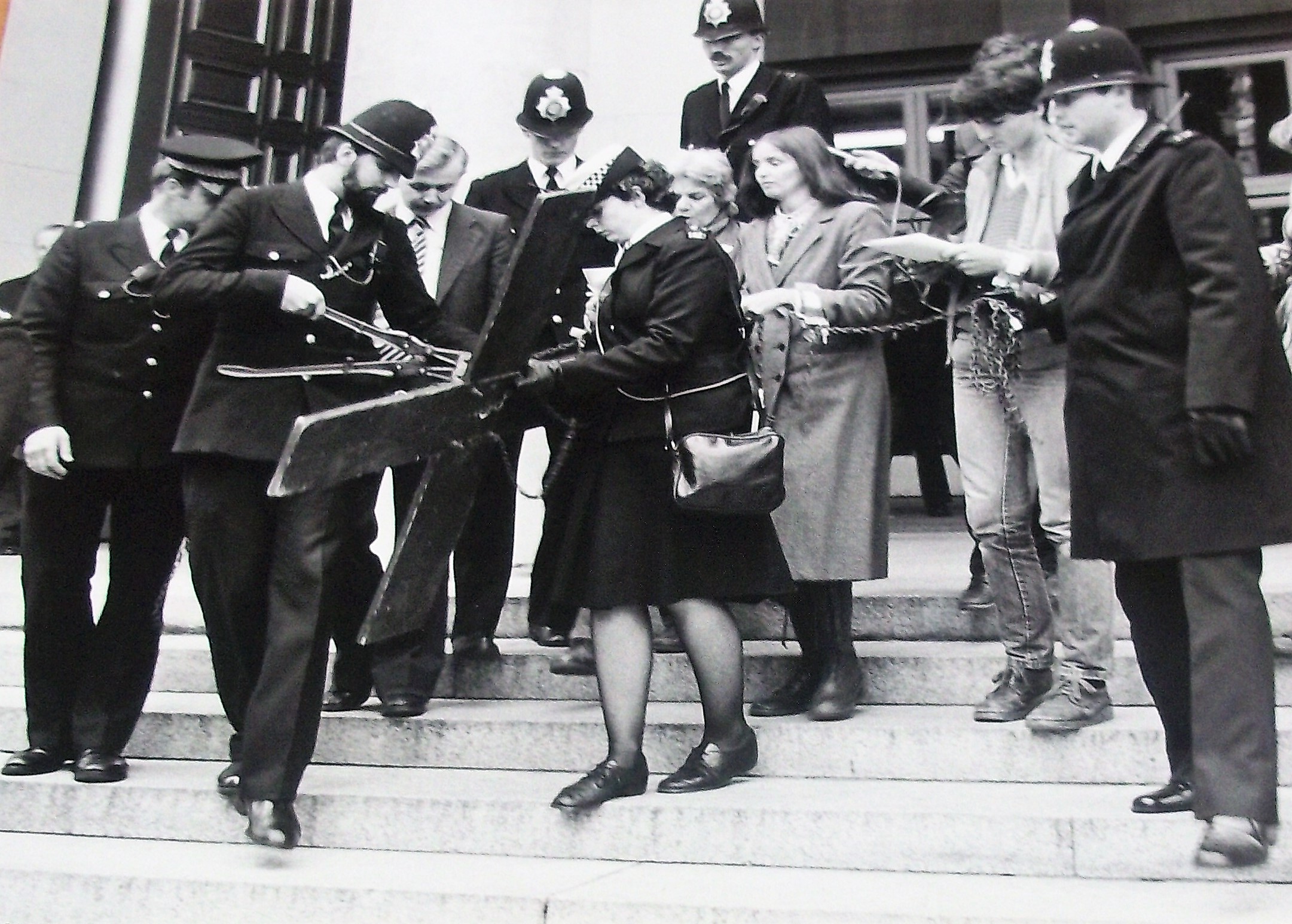
Carmel is arrested for the first time, outside the Ministry of Defence, in 1983. She and others in CPA had chained themselves to an eight-foot wooden cross. Photos: Carlos Reyes
Carmel Martin (above just right of centre) belongs to a group of Christians who campaign for nuclear disarmament through “civil disobedience”. That means they’re liable to land in prison. Margaret Hebblethwaite spoke to Catholic Peace Action
Carmel Martin strides up the steps of the Ministry of Defence carrying a large, round loaf of home-baked bread marked with a cross. At her side are two fellow protesters from Catholic Peace Action, one with a basket of flowers, the other with a letter for Michael Heseltine.
“I am very afraid,” said Carmel, as she walked down Whitehall on the way to the Ministry, “I’m hoping not to be arrested, but if they don’t receive the gifts then we will refuse to move.” Carmel, a mother of two small boys, has been arrested three times and has served one prison sentence.
Inside the Ministry of Defence are glass security partitions and double doors with red and green lights above. The three women speak to a receptionist who immediately recognises the name Catholic Peace Action. “l take your leaflets to a little prayer group I go to and I agree with you,” she says, and then claps her hand to her mouth as though she should not have said it. She rings for Mr Heseltine’s representative and says, “‘He’ll be down in a minute dear.’
A tall man with a grey beard comes down to reception. By now sounds of hymn-singing are floating through the doors. As the rest of Catholic Peace Action hold a demonstration on the steps of the building the women explain that they have been fasting for three days and that they bring these gifts as signs of light/life and hope to all the staff and to express their concern at the work that goes on in the building.
Mr Heseltine’s representative nods understandingly and says. “Well, thank you very much.” and “l fear I have to rush straight up again.” Important work calls him — the work the women are protesting against. It is a courteous exchange. But meanwhile security guards – some in uniform, some in plain clothes and with walkie-talkies – have rushed to the entrance of the building and are preventing anyone entering or exiting. They stand at the top of the steps, trying not to over-react.
All goes well and today the demonstration is successfully completed without arrests.
Carmel has an open face and long, straight brown hair falling down her back to below her waist. She wears a simple, gold cross on a chain.
Daniel (four) and Sean (two) need encouragement to eat their Ready Brek. It is an openly Christian home. Daniel wants his daddy’s beard “to grow like Noah’s”, and Leonardo da Vinci’s head of Christ from the Last Supper gazes down from a calendar on the wall. “We have plenty, ” says Carmel, “but we don’t have extra money. “At the moment we have £3 in the bank”. Carmel trained as a teacher of Art and taught in Grimsby and London before going over to California where she met Dan. They both began to “work for peace” out in America, but have been back in England now for four years. “There is a greater need at the moment for the work of civil disobedience in England. It’s just beginning to take off, but two years ago it was just being talked about.”
To explain the need for civil disobedience she tells the story of Hiroshima survivor Setsuko Thurloe. “She was 13 when the bomb fell on the school she was in. She just remembers the darkness, and the children crying. She happened to be on the edge of the building and somebody pulled her out just before the school ignited and the rest of the children were burnt to death. She lost all her family. Her sister and her niece were vaporised in the centre of Hiroshima, and she said that for years she felt a tremendous pain — not because she had been a victim of the bomb, but because of the silence of the Church.
“She says that the only thing which eases that pain is that she knows people in America are actively involved in civil disobedience and are suffering for speaking out against it — two are serving 18-year sentences for damaging a missile. That validates what I am doing for me.”
Carmel and Dan helped to found Catholic Peace Action, which they call an “affinity group”. “We arranged a four- day retreat which we held here in the house, and we began with a commitment to non-violence, to prayer and to Civil disobedience.”
So far, Catholic Peace Action has held six actions at the Ministry Of Defence, which they also leaflet every second Friday, handing out 500 leaflets in an hour. “We get quite friendly with them. They give us lovely smiles and say. “Oh, it’s Friday again, nice to see you. We’ve met with several of the people who work there and we’ve had letters — people disagreeing with us — and it’s the opening of a dialogue.”
Every fortnight the group meets for a meal, for prayer and reflection together, and to plan future action. One member is an anaesthetist at a London teaching hospital. Another works for a famine relief agency. Another works full-time for the homeless. The group itself, in addition to protesting against the bomb, also takes it in turns to help out twice a month at the Manna Centre, Melior Street, where homeless men can come in during the day to have soup and bread and shelter.
When I met Carmel and Dan they had a homeless lad from Rotherham staying with them while he looked for a job. He had stopped them as they came out of a Vivaldi concert, to ask them for money, but instead they took him home. The group sees the issue of bombs and world hunger as crucially interlinked. “We want the money redirected to those who are starving. I think the greatest suffering that anyone can have is not suffering themselves but watching a child suffer and I feel complete empathy and agony for the mothers who have to watch their children starve to death. Twenty-one children die from hunger every minute, and meanwhile 51% of all scientists are working on defence-related projects. There comes a time when we have to speak out and say that things have to change. The bombs are falling now and they’re falling on those who are starving.”
Carmel thinks the most likely outcome of the arms race is a catastrophic nuclear accident. “In 1979 the Americans came to the point where they were six minutes away from firing nuclear weapons because their computer registered a nuclear attack. Miraculously it was discovered it was a flock of geese. Six minutes,’ What are we risking? We’re risking the whole of creation being destroyed as the result of an accident. That seems to me to be the ultimate blasphemy, when you can choose to destroy God’s creation.
“One of our group [Sarah Hipperson] lives at Greenham Common, and when the nuclear weapons convoy comes out, the people involved with putting it on the road don’t know at the time whether it is an exercise or whether it is the real thing. Children of air base personnel are taken from their beds at four o’clock in the morning and put into shelters. They don’t know either if that is an exercise or if it is the real thing. As a Catholic I couldn’t be part of that. It’s easy to depersonalise when you’re working with papers and files, it’s easy to fool yourself and say this isn’t really what I’m doing. That is the position a lot of people are in, either they can’t face it or they choose not to.”
And so one of the aims of Catholic Peace is “to try to bring about some conversion of heart, and as a group we have seen that take place. During our first act of civil disobedience in April 1983, I experienced the power of the Holy Spirit in a profound way. Other people did too — it wasn’t just me.
“We poured ashes and our own blood on the steps of the Ministry of Defence, and then knelt in prayer. We used the symbol of blood because it represents the choice between life and death, and for those in the third world it’s a reality — they are losing their life’s blood slowly through starvation or through persecution. We wanted to use a symbol as powerful as the evil we are trying to resist.
“After that act of civil disobedience the gospels took on a new meaning for me. The feeling and the enlightenment — Pentecost must have been like that, when the Holy Spirit came down on the disciples with tongues of fire. It was as though I saw things with new eyes.
“It left me with great hope, and that hope is very marked for me, because previously I had been despairing of the situation, sort of in the darkness. I had been completely powerless, but then I was empowered again and given a renewed sense of hope.”
Sarah Hipperson and Carmel Martin, during the same witness in October 1983.Part of the liturgy in the porch area of the Ministry of Defence, during a previous witness.
Carmel’s first arrest was on October 11, 1983 after she, and others, had chained themselves to an eight-foot cross on the steps of the Ministry of Defence. She was asked to sign an undertaking to keep the peace. “It was three days before Christmas, and although previously I had decided I was not going to sign, because I felt that the peace I would be keeping was different from the peace the court was asking me to keep, when it actually came to doing that and spending Christmas in prison away from my family, I could not refuse to sign.
The second arrest was on Ash Wednesday. 1984 when the protesters marked their foreheads with ashes and Carmel wrote “Repent” on the pillars of the Ministry of Defence with charcoal. “We took the message of “Repent” from the Ash Wednesday liturgy. We are not only repenting of our own silence and sinfulness in contributing to the build-up, we are asking the people in the Ministry of Defence to do the same thing, and through them, the Government and the nation.”
Carmel was given a fine of £50 or seven days in prison. “Think about the children,” said the magistrate trying unsuccessfully to persuade her to pay the fine. Carmel says. “l thought that was so ironic. I am doing this partly because of the children.
When she turned herself in before serving her sentence she found she was able to explain the whole thing to the policemen. At the end of the conversation one of them said, “I’m a Catholic. I know you’re right, we all know you’re right.” It seemed that because I was prepared to pay some sort of price for what I believed in, the ears of the policemen were opened.”
Carmel was admitted to Holloway, together with some of her friends. The admission procedures took eight hours and included a medical examination, which Carmel refused, and a strip search. All the women admitted on a particular day are put together, not separated according to crime. We were mixed with drug addicts, burglars, and the first thing people ask you is, “Why are you here?” Someone who I found out later was a prostitute said to her friend “She could be a spy.’ I said. “No, I’m a peace protester.” She said you look so innocent.”
Three of the protesters ended up together in the same cell. “We were treated with respect by the other prisoners because we were able to discuss it with them and by the warders for the most part. The worst thing was that time dragged terribly. You were always waiting for the meal, the mail.”
Carmel’s third arrest took place this year on a day of bitter cold and Snow — January 15, the birth date of the black civil rights leader Martin Luther King. She was to be tried on the day after I spoke to her. Catholic Peace Action had carried a large candle to the Ministry of Defence, as a symbol of Martin Luther King’s fight against poverty, war and injustice, and as a symbol of the light of Christ in the world. They put a poster on the centre door of the Ministry of Defence which read ‘Unarmed truth is the greatest force in the universe’, and they chained themselves to the door while they held the usual prayer service.
Carmel said about the prospect of the trial: “I’m nervous. I feel it is such a responsibility to speak the truth clearly and I sometimes think I am not really the best person to do that because I am so illogical. You’ll know if I’m nervous because my voice goes very high.
“Before the last trial, I wouldn’t have been able to talk to you about it because I was so upset, because of the emotional strain of leaving the children. For me, being with the children is a priority — I choose not to work because I want to share the time with my children while they are little, so it was really wrenching. In court, I was extremely nervous but I was able to speak. I think the Holy Spirit gave me strength.”
Carmel suspected that she was likely to be given a fine of around £85 with the penalty of about 14 days imprisonment for not paying. “At the moment the children don’t know that I may be in prison but I will tell them that I may be gone for a while but I may not. I am very fortunate that Dan fully supports me and we have interchangeable roles. He’s very good with the children and does everything.
“We have the Catholic Peace Action meetings at the house here, so Daniel, one of our sons knows all the people very well. He knows that periodically Sarah is in prison, or Ray is in prison, Or Pat is in prison and I go to visit them. Last time the only reference he made was when I came out, and he said, ‘Why did you have to go to prison?’ and I said. ‘l had to go because I have to work for peace. so vou can grow up and be happy.’ And he said. • I don’t want you to work for peace any more if you have to go to prison. “
l wish there was another way. It would be great if someone would say to me, ‘you don’t need to do this.’ I would listen, because I don’t do this because I enjoy doing it. I do it because I think I have no choice.”
The next morning at Bow Street a little crowd of about 20 supporters turned up to attend the trial. Outside the door of the courtroom they held a little prayer service while half a dozen policemen laughed and joked on the other side of some glass swing doors. The prosecuting counsel walked through the praying group respectfully.
The five prisoners defended themselves. “Could you read the marked passage from the sheet we handed out at our demonstration?” asked one of the protesters of several police witnesses in turn. “It is a quotation from Martin Luther King. “
The policeman, who had just mumbled through his oath to Almighty God took the paper, coughed and read. “We come today as always in a spirit of friendship and love.” “Would you say,” asked the defendant “that the action you witnessed was in accord with that spirit of friendship and love?”
The Inspector looked flustered. The Constable twitched his lip and said. “Well, sir, I’d say it was.”
The magistrate, who asked for a copy of the sheet afterwards to take home for his daughter who was doing a school project on Martin Luther King, looked over his half-lensed glasses and pronounced that he was quite satisfied that it had been a gentle, peaceful, well-mannered demonstration. Technically – “and I emphasise technically,” he said — he found them guilty of obstruction, but his sentence was an absolute discharge. And he added, “I am very grateful for the way in which the defendants conducted their case — with courtesy, discretion, intelligence, and. for the most part with relevance.”
“I’m feeling fantastic, lost for words” said Carmel, immediately afterwards.
Less than one month later. Carmel was on the steps of the Ministry of Defence again risking arrest in another act of civil disobedience. She will not be easy to silence.
Once again Peace Sunday is being commemorated in churches up and down the country. To mark the occasion Dr Ray Towey explains how non-violent civil disobedience can bring about a world `no-go’ area for nuclear armaments.
IN A NUCLEAR weapons state Christians who pray for peace on Peace Sunday should consider the possible consequences. Prayer has a way of leading to action and to me this has resulted in three sentences to Pentonville Prison, What is it that moves Christians who are otherwise quiet and law abiding citizens to acts of non-violent civil disobedience for peace? It is because they have realised that in their country something is happening which is monstrously evil — the sincere plans for nuclear war with which many other Christians are scandalously implicated. To be faithful therefore I these normally law abiding people must speak out and act.
The immorality of nuclear deterrence has been succinctly described by the Scottish bishops in their 1985 peace message: “If it is immoral to use these weapons, it is also immoral to threaten their use.”
The Church, however, is more than a set of moral principles. The church is called to be a community of love, a living witness of Christ in the world. Each of us by our baptism are called to be missionaries and the world learns of Christ by the way we live the Gospel values.
In what sense can a genuine threat of nuclear genocide be compatible with proclaiming the Good News of Christ? If the Church does not clearly extricate itself from any possible support for preparations for nuclear genocide then its mission as a light to the world is fundamentally threatened and when the missionary life of the Church is threatened, the life of the Church itself is at risk.
Our nuclear weapons destroy our own spiritual life and Christian witness before they destroy our enemies’ physical life.
The intention to use nuclear weapons violates-God’s law and plan for creation. Nuclear weapon states have a moral posture which is fundamentally flawed and consequently forfeit the total obedience of their citizens. Christians in a nuclear state have a responsibility to stand in the way of preparations for genocide.
Nuclear weapons are protected by secrecy and the legal framework of the state. Engaging in non-violent civil disobedience challenges the moral basis of the laws which protect nuclear weapons, exposes the moral crises we are in and effectively distances the Christian from any complicity with the nuclear system of values. It withdraws consent and symbolically demonstrates the choices we have to make.
Done in a Christian nonviolent way and in a spirit of evangelisation and faith, Christian civil disobedience has a real power of conversion. It follows a line witness of Franz Jagerstatter and the life and example of Dorothy Day. In this sense non-violent civil disobedience is Christian obedience. For me it has resulted in three arrests and three prison sentences.
During one of my trials in June 1984, Bishop Gumbleton, Vice-President of Pax Christi International, sent a strong letter of support on behalf of a co-defendent, writing that she had acted sincerely and faithfully as a Catholic in her non-violent civil disobedience.
When Bishop Emerson Moor auxiliary in New York, was arrested on December 5 1984 while illegally blockading the South African consultate in New York, he became the first Catholic bishop in the United states ever to be arrested for an act of civil disobedience. The issue in this case was the current genocide of apartheid and not nuclear genocide, but the principles are comparable. Archbishop O’Connor of New York defended the action of his auxiliary bishop, pointing out that there must be instances when an illegal act is seen as “the only way to bring about the revocation or modification of intrinsically immoral law.”
The non-violent witness against nuclear weapons has been going on longest in the United States with thousands of people going through the courts and prison. In our own country Christian civil disobedience is going to be a continued Christian calling while we remain a nuclear weapons state.
We live in a time when the sanctity of human life is everywhere under challenge. The Church has spoken out courageously for the life of the unborn child and for the protection of the human embryo. We should not hesitate now to repudiate and resist any system of values which can contemplate the killing of millions of human beings in the name of national security.
Dr Towey is a member of Pax Christi and Catholic Peace Action as well us a consultant anaesthetist at a London teaching hospital. This was first published in the Catholic Herald, 1 February 1985.