(Scroll down – below the PDF – for full text/speeches from Carmel and Ray.)
In May of this year (1986), Catholic Peace Action was invited to send two representatives to the International meeting of Pax Christi to present a workshop on civil disobedience.
Carmel and Ray went on behalf of the group to the conference, which took place in Vincenza, Italy. We offer you the content of what they shared in their workshop.
_______________________________________________________________________
Speech by Carmel
I would like to begin by introducing ourselves. My name is Carmel Martin and the other member of CPA here with me is Ray Towey. We have been asked to make a contribution on the subject of civil disobedience. We have been described as experts but we are not. If we were we wouldn’t be so nervous! We are members of a group that has existed since the summer of 1982 and who are trying to discover what it means to be faithful in the nuclear age. I will give a brief background of the group. Ray will then reflect on the subjects of civil disobedience, communication with those directly involved with war preparations, and the Church; I will then close with some thoughts on how we express our faith at the Ministry of Defence, and the consequences.
The formation of CPA occurred after a number of individuals had met during periods of pilgrimage, prayer and fasting. Our meeting we feel was a gift from God. There were seven of us who after some discussion and prayer had decided to be more fully committed to nonviolence, compassion for each other and to preparations for witness against the nuclear threat by engaging in non-violent civil disobedience.
We agreed that the doctrine of nuclear deterrence is incompatible with the will of God, and in regard to nuclear war preparations, civil disobedience is Divine obedience.
At our first few meetings we did not give ourselves a time limit as to when we would engage in civil disobedience. We wanted to remain open to the Holy Spirit.
Civil disobedience is a spiritual calling and a matter of discernment. In fact the process of discernment, and personal and group spiritual preparations prior to civil disobedience are as important as the action itself.
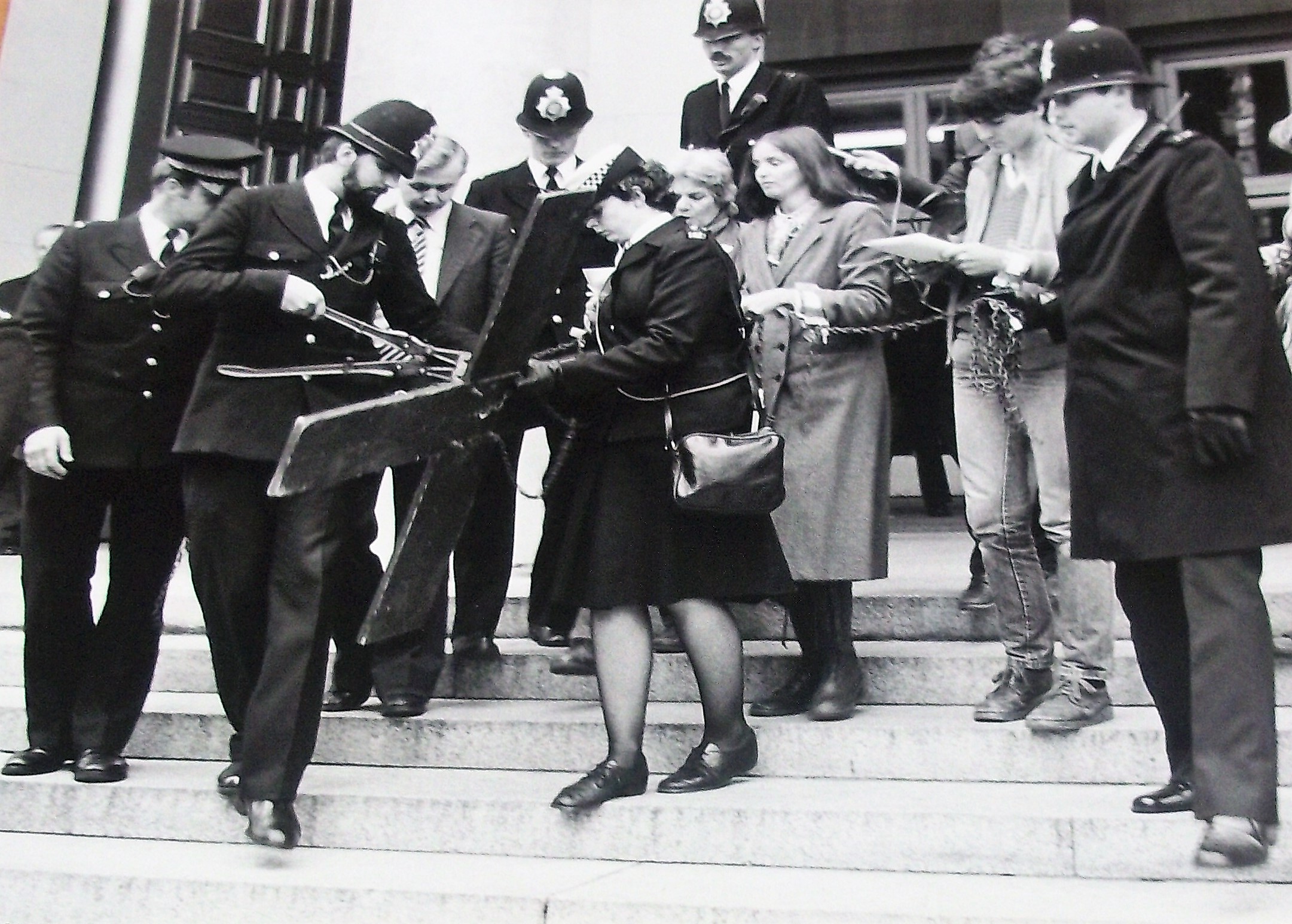
Since April 1983 we have been involved in nine acts of civil disobedience, which have resulted in over 50 arrests and 140 days in prison. The other part of our peace work involves communicating with the workers of the Ministry of Defence. Since August 1983 we have given the workers a message through a twice-monthly leaflet which expresses our concerns on peace, disarmament and their work.
Our group is not just concerned with action but with each other. We meet regularly not only to plan the next action but to share a meal, pray, discuss things and enjoy each other’s company. Two of the original members are no longer with us and others have joined and stayed for various lengths of time. We are an affinity group not a membership organisation. However we do put out a newsletter and our supporters help us through prayer, financial contributions and joining us at the Ministry of Defence in the work of communication and during our days of civil disobedience. More recently, we have started open/public meetings for the purpose of bringing others more closely into the prayer and spirit of the work.
Ray made his contribution at this point:
My name is Ray Towey. I work as a fulltime hospital doctor in London. I have been a doctor for 19 years and for 3 years I worked in Africa of which two were spent at a Catholic Mission Hospital.
As Etienne said in his preaching so eloquently this morning at Mass, my own exposure to the diseases of poverty have had a deep effect upon me, and my understanding of the Church’s option for the love of the poor, Christian peace making and the contribution of lay missionaries to the growth of the Church. Over the last 2 and a-half years I have been arrested by the police 5 times and I have been sent to prison for 3 short prison sentences. It is from this situation I wish to give you my reflections.
Catholic Peace Action is essentially a response by a small group Of Christians who have come to the realisation that a monstrous evil has developed within their country, namely sincere plans for the use of nuclear weapons, that is sincere plans for nuclear genocide. The deployment of Cruise missiles in 1983, the planned building of the Trident submarines and the refusal to support a comprehensive test ban treaty, have all exposed the failure to commit our country to a process of nuclear disarmament which the teaching of the Church clearly demands.
We see the policy of deterrence as incompatible with the Gospel values, and a blasphemous denial of Jesus as the Lord of history. In our society the willingness to engage in nuclear war has put the security of the state above all moral considerations. When the state assumes such awesome and immoral intentions, which has been described as idolatrous, the Christian community to be true and faithful to its vision of God’s will for humankind, must respond, speak out and preach the Gospel. Nuclear weapon states have a moral posture, which is fundamentally flawed and consequently forfeit the total obedience of their citizens. CiviI disobedience is an attempt to speak out with clarity in a way which appropriately reflects the seriousness of our situation. Nuclear weapons are protected by secrecy and the legal framework of the state. Laws which in themselves are not immoral, are used by the state to protect a policy of nuclear genocide.
The policy itself is protected and paid for by a process of normal good citizenship, the payment of taxes and the rights of property and land. Civil disobedience challenges the moral basis of laws which protect nuclear weapons and nuclear war planning. It exposes the moral crises we are in and distances those who participate from complicity in the nuclear system of values. It draws on the prophetic ministry of the Church in exposing the slow and subtle way in which the state has entrapped the Church within its own system of values.
The preaching of the Gospel of non-violence and the unity of all humankind, which nuclear weapons deny, must, be done not under the conditions or control of the nuclear weapons state but in opposition to and in non-violent confrontation with the nuclear system of values. To us civil disobedience is an open clear non-violent breaking of certain laws which place us in direct confrontation with the authorities of the nuclear weapons state.
Combined with civil disobedience, dialogue with the supporters of nuclear deterrence is an acknowledgement of both the need and the possibility of conversion to peace. Dialogue is an essential requirement in respecting the dignity and humanity of our opponent. Civil disobedience without dialogue is a cynical and flawed appreciation of the humanity of our opponent to understand and choose the non-violent alternative. However dialogue without civil disobedience does not fully relate to the danger we are in, the moral crises which surrounds us, and the capacity we have with trusting obedience in God to confront the values of the nuclear state. Civil disobedience re-establishes the authority of the Church, which transcends human laws at a time when human laws protect the means of genocide.
“Resistance (civil disobedience) without dialogue is cynical, dialogue without resistance is sentimental” (Jim Douglas Ground Zero Community USA)
For us dialogue involves twice-monthly legal leafleting of the workers as they enter the Ministry of Defence in the morning. This persistent twice-monthly presence continued now for over two years has made us well known to the workers. Many of the workers are keen to receive our leaflets, they understand our position and a very few communicate back to us. We have built up also a respect with the police who arrest us and it is not unusual for us to engage in discussions on the nature of deterrence, the limitations of obedience to the law and the reasons for Christian resistance. In the courts also we have established a moral presence and a mutual respect where our motives and values are discussed. We see these as signs of hope in the capacity of society to begin to make a change of heart to peace and disarmament.
The place in which we choose to break the law is the headquarters of our military planning the Ministry of Defence in central London. It represents the centre of our country’s nuclear war planning. Everyone in our group live near central London and for most of us this is our nearest nuclear war planning establishment.
Scattered throughout Europe all of us live in close proximity to the places for nuclear genocide and all of us could begin to challenge the military communities with the values that the Christian communities profess.
We are not saying that civil disobedience is the only way to proclaim the Gospel of Peace in a nuclear weapons state. The failure of my country to commit itself to a plan for nuclear disarmament and its continued preparations for the use of nuclear weapons breaks the conditions for nuclear deterrence demanded by current Church teaching.
The opportunity for the Church to engage with this situation within the legal framework of the state has substantially not been made.
Our acts of civil disobedience are a prophetic call to take these legal opportunities, which could awake the consciences of many both in the Church and outside the Church. What is at stake for the Christian in a nuclear weapons state is the authentic life of the Church itself in our time “The Church seeks but a solitary goal, to carry forward the work Of Christ himself.” (Gaudium et Spes.)
The Church is called to be a living witness of Christ in the world, a community of love open to the whole world. If the Church does not extricate itself from any possible support for nuclear genocide then its mission as a light to the world is fundamentally threatened and when the missionary life of the Church is threatened the life of the Church itself is at risk.
We see our actions as a call to renewal in the life of the Church so that Christ will be seen more clearly in the world. We see our actions as rebuilding the Church at its very roots, as a call to conversion and as establishing the authority and identity of the Church in our own society.
We have begun a dialogue with a small number of our own bishops to seek their support and to convey our own vision for their discernment. We dialogue and reflect with Christian peace activists of other traditions to share and reflect where the Holy Spirit is leading us. We see real signs of conversion to peace both in and outside Church structures, which gives us strength in our non-violent choice and hope.
–End of Ray’s presentation–
Carmel continued with her presentation at this point:
Because our acts of civil disobedience/Divine obedience are firmly rooted in our belief in God, as members of the Catholic Church we use the symbols of our faith when we go to the Ministry of Defence. Christians working for peace need to be able to use the forms and symbols of religious observances to help them confront the violence and injustice of our day.
Through the use of religious symbols our witness and message are graphically conveyed with a clarity and strength that words alone could never match. Involving religious forms and symbols outside the confines of the church buildings has a three-fold effect.
The first is to help the individual resister in his or her particular witness. Faith is strengthened when the forms and symbols of faith are near and in use. Secondly, they convey to a largely indifferent and sometimes hostile public that something more than just a political statement is being made. And thirdly, they challenge the Church and other members of the Church to move away from a solely individualistic and enclosed view of religion.
For these reasons and others we have always engaged in civil disobedience at the Ministry of Defence in the context of a liturgy and sometimes on significant liturgical dates e.g. Ash Wednesday.
The forms and symbols of our faith have included prayer, song, readings from the Bible, preaching, the rosary, ashes, blood, a cross and bread. For us and our supporters such forms and symbols are given greater authenticity and deeper meaning when used in close proximity to symbols of death and violence, and by people who are taking risks and willing to suffer for the cause of peace.
To give one example: For the past three years we have been involved in an Ash Wednesday service at the Ministry of Defence. We meet first to pray, bless the ashes and read the bible. We mark our own foreheads (with ash) saying the traditional: ‘Repent and believe in the Gospels.’ We then walk to the Ministry of Defence building where with charcoal we mark the façade with a cross or the word “repent”. Those who mark the building are arrested and the others continue with the liturgy. By such actions we are calling ourselves and our nation to personal and corporate repentance.
By using the traditional forms and symbols of our faith we are saying to our Church and fellow Christians that this is one place where the Church should be on Ash Wednesday; and this is one way the Church should behave on Ash Wednesday.
Indeed, because we stand within our tradition we are saying that we are Church and doing our duty as Christians/Catholics.
Our work resulted in arrests, court appearances, and imprisonment, but these consequences would be completely without significance if they did not indicate a deeper spiritual struggle to live more non-violently and faithfully. For nonviolence is not confined to peace work at the Ministry of Defence but involves questions of lifestyle, the bringing up of children, and assisting the poor. The act of civil disobedience and all that follows is an expression of my struggle to achieve a more complete disarmament and conversion of heart. This conversion does not come easily.
My personal involvement in civil disobedience, and I have risked arrest five times, were acts of despair for the life of this world and my children’s future. (I have two small children and as you can tell, one on the way). I felt and still feel the need to somehow stand in the way of nuclear war preparations. But because of the risks I have taken my despair has decreased and I have experienced a renewal of faith and hope.
When one looks at the state of the world and especially the nuclear arms race there can be little reason for optimism. But hope is a gift from God. It is tangible and it is made more abundant through the doing of justice and the making of peace.
Real hope generates hope. Our experience is not unique. In our relationship with friends, the police, prosecutors, and magistrates we have seen a conversion of heart that simply could not have taken place had we confined our peace witness to words and legal, non-arrestable actions. This conversion comes through risking and suffering done in the spirit non-violence.
Some Defence workers, prosecutors and police have said they agree with us. When one of our members went to prison, the first nun since the reformation to be imprisoned for an act of conscience, she received over 1,000 letters of support from all over the country. Here was a church acting out the hope it so often proclaims. Despite what I have just said, engaging in civil disobedience is still extremely difficult for me.
A supporter of ours warned us two years ago that we as a group are open to charges of conspiracy and therefore could receive heavy fines and long prison sentences. Ray responded by saying: ‘The Church should be a conspiracy for peace.’ We have continued our conspiratorial ways and encouraged others to join us or form their own groups of prayer and resistance. It is these communities that will successfully confront military madness and bring us back from the nuclear abyss. Only when Christians make absolutely clear their total opposition to nuclear war preparations will the pseudo-Christian arguments which politicians and militarists use to justify their policies be exposed for what they are: arguments for genocide. In a generally wealthy and comfortable society the taking up of the cross of militarism is an option that it too easily ignored by our Church and fellow Christians. However, communities of prayer and resistance will be able to survive social penalties and Church silence and build a network that will transform both.
Constant conversion and persistent struggle will turn the tide. After an act of civil disobedience last August 9th, the police inspector, for the first time in 2 and a-half years, sat down with those of us he had arrested and asked, “why?”
The day will come and may it come soon, when heads of governments of all nuclear weapons states, will ask Cardinals and Bishops the same question: “Why are the people of your Church so disobedient?”


